Saturday, June 11, 2016

Plant Family of the Day: Acanthaceae

Aaaah, Acanthaceae.  The spiny, thorny family.

The clock vines, the shrimp plants, the chuparosa...

The latter one is native to dry areas in SoCal, and it makes a wonderful hummingbird plant.  It doesn't seem to grow here in SF, but still good to know.

Justicia californica  - the chuparosa

At first glance, it reminds me greatly of a sage.  And this is no surprise - both Acanthaceae and Lamiaceae fall under the same order: Lamiales.  The order of tubular flowers.  

TO BE CONT.

Thursday, September 10, 2015

Save the Buckeyes!

Nature really is a complicated beast - and as part of nature, we ought to appreciate the complexity.

All over North America and Europe, we've been seeing the decline of bees for the last several years.  We don't know the definitive cause(s) yet, though we can guess at the factors (pesticides, colony diseases, global warming, etc).  So as a result, we've been a lot more concerned about "saving the bees" - that means going organic and planting flowers that can act as food sources to our hardworking honeybees.

Did you know that some species of flowers are actually poisonous to honeybees?

I didn't either.  But apparently some flowers have compounds in them that can poison and even kill bees.  Here is a partial list: http://www.buzzaboutbees.net/Plants-Toxic-for-Bees.html

Now, in our typical extreme way, we might say "kill all the plants that kill the bees!"  But then where would we be?  Without plants that are certainly very needed in our world - else why would they exist?  Promoting one species ought not come at the near-extinction of another species.

Take the California Buckeye (Aesculus californica) for instance.  It is one of the plants that is toxic (and potentially fatal) to bees.  And yet that same plant is a very rich nectar source for butterflies.  Not to mention, it is a soil binder.  That means it prevents erosion, especially in areas with a lot of hills, like - oh, say - most of California!  In short, the world needs this plant!  It has a place here.  But then again, so do the bees.  So where's the middle ground?

Instead of cutting down all the California Buckeyes we see... how about we just don't plant them next to apiaries?  Sound like a fair compromise?

Friday, June 27, 2014

The sea stars are dying

Sea stars.  We know their beauty.  Their bright colors and tenacity to cling to the rocks regardless the tide.  I'd include a photo here, but there might not be many of them left to take photos of.

They are dying.  According to friends, dissolving and melting away within 24 hours to 2 weeks of being exposed to a pathogen.  "Sea Star Wasting Syndrome".  The main cause is the rising of the water's temperature worldwide, and the upcoming ENSO (El Nino Southern Oscillation) cycle will only amplify it.

I have two questions:
1) Where is the pathogen coming from?
2) How can we cool the water temperatures worldwide?

Answers:
1) We don't know. We don't even know what pathogen it is, if it's even a pathogen.  Therefore, with not knowing, half the battle is lost.

2) It would take a long time to reverse global warming.  But if there's any way to do it, it involves storing the carbon dioxide back into the environment.  That means, more trees and more plants.

The ocean is usually a giant carbon sink, meaning that when it is cold, it absorbs the carbon dioxide.  When the ocean heats up, on the other hand, it becomes a giant carbon source.  70% of the planet giving off previously-stored carbon dioxide, meaning that then the planet gets even warmer, which leads to even more carbon dioxide being released… Positive (and not in the "good" sense necessarily) feedback cycle: the change grows on itself.

We need to cool the ocean down.  We need to plant more trees on land.  What we do on land directly affects what we do in the ocean.

Now, how can we restore the lands to their natural forest states?

What are the forests that are closest to San Francisco?

Saturday, April 19, 2014

Low VOC emitting trees

A link of trees that emit low VOCs:
http://raqc.org/images/uploads/Species_List_of_Low_VOC_and_Medium_VOC_Trees_From_the_Center_for_Urban_Forest_Research.pdf

It is said* that these trees are the best placed in urban environments - larger stands of trees overall lower VOCs, but when the trees are spread apart, the potential for VOC emission is increased in urban environments.

* in this article:  http://www.ncufc.org/uploads/nowak_trees.pdf

Let's find out a little more about these trees:

1. Arbutus unedo - also known as Strawberry Tree, hailing from the Heather Family (Ericaceae) - native to Mediterranean Europe - related to the madrone - edible fruits.

I wonder if the more local Arbutus menziesii would have similar low VOC emissions?

Image from Wikimedia commons: Arbutus unedo

2. Cercis canadensis - also known as Eastern Redbud, hailing from the Legume Family (Fabaceae) - native from Canada to Florida (eastern U.S.).

There is a species native to California called Cercis occidentalis… would it have similarly low VOC emissions?

Image from the NPS.gov: Cercis canadensis

3. Cinnamomum camphora - also known as Camphor Tree, hailing from the Laurel Family (Lauraceae) - native to China, though naturalized in parts of California - having trouble finding a true native relative within the same genus.

Image from Wikipedia: Cinnamomum camphora.

4. Citrus limon - also known as the Meyer Lemon, hailing from the Citrus Family (Rutaceae) - native to China - grown in many gardens worldwide.

Image from Wikipedia: Citrus x meyeri.

5. Fraxinus velutina - also known as Modesto Ash, hailing from the Jasmine Family (Oleaceae) - native to SoCal, Arizona, Texas and Mexico.

There is an even more local species within the same genus - Fraxinus dipetala - would it have similarly low VOC emissions?


Image from Wikipedia: Fraxinus velutina.

6. Hymenosporum flavum - also known as Sweetshade, hailing from the Pittosporum Family (Pittosporaceae) - native to Australia.  No native relatives found.


Image from Wikipedia: Hymenosporum flavum.

7. Jacaranda mimosifolia - also known as Jacaranda or Fern Tree, hailing from the Bignonia Family (Bignoniaceae) - native to South America.


Image from Wikipedia: Jacaranda mimosifolia.

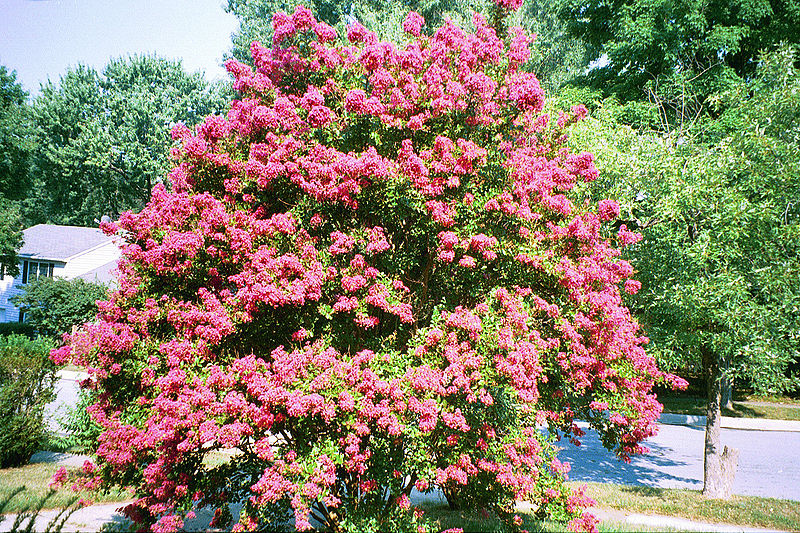
8. Lagerstroemia sp. - also known as Crape Myrtle, hailing from the Loosestrifes Family (Lythraceae) - native to Oceania.

Image from Wikipedia: Crape Myrtle.

9. Pittosporum rhombifolia - also known as Queensland Pittosporum

10. Podocarpus gracilior - also known as Fern Pine

11. Pyrus calleryana - also known as Flowering Pear

12. Ulmus americana - also known as American Elm

13. Ulmus parvifolia - also known as Chinese Elm

14. Zelkova serrata - also known as Zelkova

15. Eriobotrya deflexa - also known as Bronze Loquat

16. Eriobotrya japonica - also known as Loquat

17. Prunnus avium - also known as Bing Cherry

18. Prunas densiflora - also known as Red Pine

19. Pinus pinea - also known as Italian Stone Pine

20. Laurus nobilis - also known as Sweet Bay

21. Pinus radiata - also known as Monterey Pine

22. Cedrus atlantica - also known as Atlas Cedar

23. Ginkgo biloba - also known as Ginkgo or Maidenhair Tree

Mentioned in the Novak article, trees said to lower ozone:

24. Morus sp. - Mulberry

25. Prunus sp. - Cherry

26. Tilia sp. - Lindon

27. Gleditsia sp. - Honey Locust