http://raqc.org/images/uploads/Species_List_of_Low_VOC_and_Medium_VOC_Trees_From_the_Center_for_Urban_Forest_Research.pdf
It is said* that these trees are the best placed in urban environments - larger stands of trees overall lower VOCs, but when the trees are spread apart, the potential for VOC emission is increased in urban environments.
* in this article: http://www.ncufc.org/uploads/nowak_trees.pdf
Let's find out a little more about these trees:
1. Arbutus unedo - also known as Strawberry Tree, hailing from the Heather Family (Ericaceae) - native to Mediterranean Europe - related to the madrone - edible fruits.
I wonder if the more local Arbutus menziesii would have similar low VOC emissions?

2. Cercis canadensis - also known as Eastern Redbud, hailing from the Legume Family (Fabaceae) - native from Canada to Florida (eastern U.S.).
There is a species native to California called Cercis occidentalis… would it have similarly low VOC emissions?

3. Cinnamomum camphora - also known as Camphor Tree, hailing from the Laurel Family (Lauraceae) - native to China, though naturalized in parts of California - having trouble finding a true native relative within the same genus.

4. Citrus limon - also known as the Meyer Lemon, hailing from the Citrus Family (Rutaceae) - native to China - grown in many gardens worldwide.

Image from Wikipedia: Citrus x meyeri.
5. Fraxinus velutina - also known as Modesto Ash, hailing from the Jasmine Family (Oleaceae) - native to SoCal, Arizona, Texas and Mexico.
There is an even more local species within the same genus - Fraxinus dipetala - would it have similarly low VOC emissions?

6. Hymenosporum flavum - also known as Sweetshade, hailing from the Pittosporum Family (Pittosporaceae) - native to Australia. No native relatives found.

7. Jacaranda mimosifolia - also known as Jacaranda or Fern Tree, hailing from the Bignonia Family (Bignoniaceae) - native to South America.

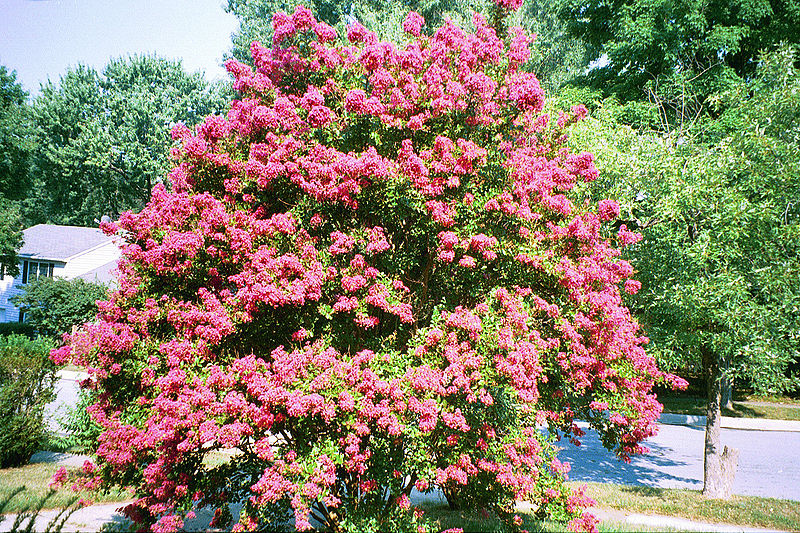
8. Lagerstroemia sp. - also known as Crape Myrtle, hailing from the Loosestrifes Family (Lythraceae) - native to Oceania.
9. Pittosporum rhombifolia - also known as Queensland Pittosporum
10. Podocarpus gracilior - also known as Fern Pine
11. Pyrus calleryana - also known as Flowering Pear
12. Ulmus americana - also known as American Elm
13. Ulmus parvifolia - also known as Chinese Elm
14. Zelkova serrata - also known as Zelkova
15. Eriobotrya deflexa - also known as Bronze Loquat
16. Eriobotrya japonica - also known as Loquat
17. Prunnus avium - also known as Bing Cherry
18. Prunas densiflora - also known as Red Pine
19. Pinus pinea - also known as Italian Stone Pine
20. Laurus nobilis - also known as Sweet Bay
21. Pinus radiata - also known as Monterey Pine
22. Cedrus atlantica - also known as Atlas Cedar
23. Ginkgo biloba - also known as Ginkgo or Maidenhair Tree
Mentioned in the Novak article, trees said to lower ozone:
24. Morus sp. - Mulberry
25. Prunus sp. - Cherry
26. Tilia sp. - Lindon
27. Gleditsia sp. - Honey Locust

No comments:
Post a Comment